
Think about audio first when designing your smart device
In a recent article published by Forbes our co-founder and CTO Luis Weruaga explains why machine learning and intentional device design significantly impact a device’s ability to capture and interpret audio accurately.
Read the full article here:
Partnering Knowles for Voice IoT
In cooperation with Knowles Corporation (NYSE: KN), a market leader and global provider of advanced micro-acoustic and audio solutions, we are developing the front-end audio software for far-field full-duplex voice IoT interfaces, such as for smart speakers and speakerphones.
The solution, based on a “3+1” microphone array with Knowles MEMS, will run in Knowles AISonic™ Audio Edge Processor IA8201 as it provides the required computing force and connectivity (128-bit four-way SIMD DSP core, 4x PDM inputs, and up to 3x I²S ports) in order to have a centric solution without additional chips.
In case you did not have the chance to see it at CES 2023 in one of Knowles showrooms, you can now listen to it in the link below.
Learning About The Pain In Acoustic Echo Reduction
After months of startup acceleration and incubation spent in our early stage, a few messages settle in your head. The one message above all is — do not build a product that solves a problem, build one that fixes somebody’s pain. Easy said, however really getting to know your potential customers and their pain is a time-consuming and energy-draining task. But an indispensable and rewarding one. And why do I care to write about that for a post in the category of technology?
It turns out retrospectively that we were using somewhat unconsciously the “lean startup” approach in the technical conception of our invention, which we believe fixes somebody’s pain as well :). Similar to asking potential customers for market exploration, our solution asks the very acoustic echo reduction (AER) system about its own pains. I know the last sounds a bit nerdish, but when you look at state-of-art solutions to detect double talk (crossings by zero, spectral coherence, likelihoods, etcetera), you start wondering which one of those really understands AER’s language. All? None?
Finding out AER pains is kind of checking whether your stomach can tolerate spicy Mexican food you have never tried before (but without the inconvenience of going to the hospital if something goes wrong). And our system is doing such a “meal tasting” as if it were for the first time, that is, every time a new type of spice. The ultimate challenge is to understand how well the system is digesting the exotic meal by listening to its reactions conveyed in its own language. Thanks to this particular interpretation of the lean approach, our technology for acoustic echo reduction is fully operative under any double-talk circumstance, be it noise, music, voice, or altogether. Towards true full-duplex hands-free voice communications.
Car Cockpit: A Sensitive Auditorium
I love cars. Who doesn’t? The need for speed and engine roar literally push me in, ignoring the very reason of car existence (to take me from point A to point B). One more persuading argument to have an A-to-B do-not-care ride is to listen to my favourite music: a car interior with sound-absorbing upholstery is an excellent music auditorium, on a par with premium over-the-ear headphones. Sound absorption here refers to the ability to attenuate “bad” sound, such as reverberation, which would otherwise challenge the equalizer of the car’s sound system. So, dear reader, at this point you may have already guessed (when not earlier from the title) that this post does not exactly deal with four wheels and six cylinders.
Straight to the point. We measured the acoustics inside a 2015 Audi A7: as expected from Audi’s audio heritage and this premium model, our measurements revealed exquisite exponential sound decay with a time constant of 10 milliseconds; in other words, bouncing sound waves die out (25 dB attenuation) after travelling only 10 meters inside the compartment. Not bad at all. We exhaustively explored the car acoustics under different situations, such as driver only, driver+passenger, front windows open, sunroof, etcetera. The results were somewhat shocking: while the time constant remains essentially stable, the acoustic “fingerprint” changes dramatically in every situation. For instance, only the incremental impact of the front passenger is as large as the acoustic fingerprint itself! Obviously, you cannot blame the manufacturer for that, but it only shows how extremely sensitive and delicate (acoustically speaking) any car habitacle can be.
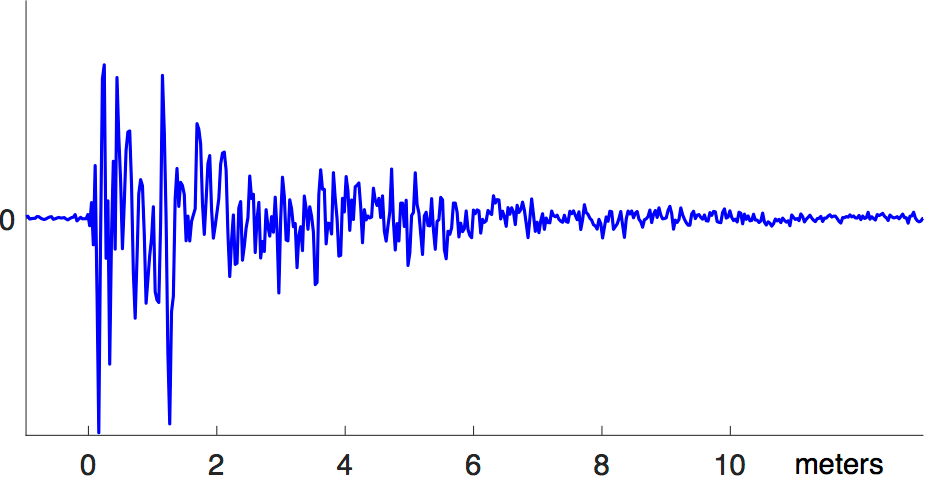
ONLY DRIVER INSIDE.
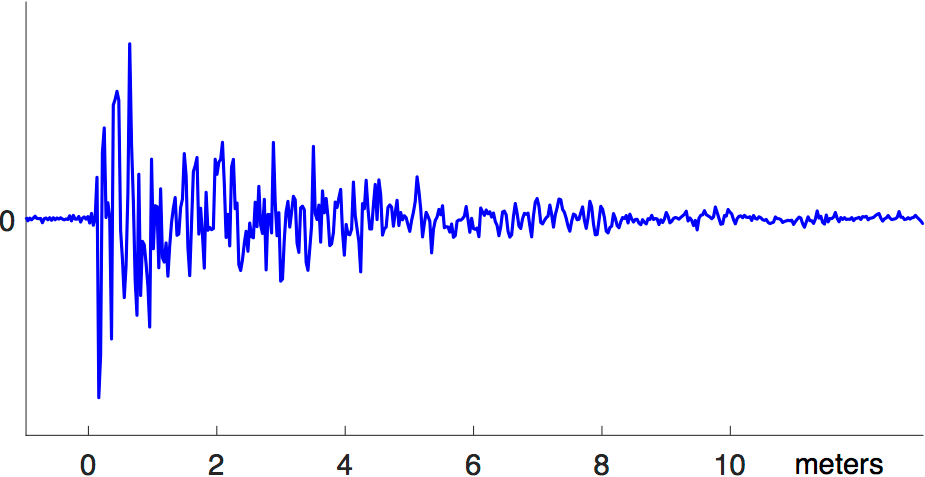
DRIVER AND PASSENGER INSIDE.
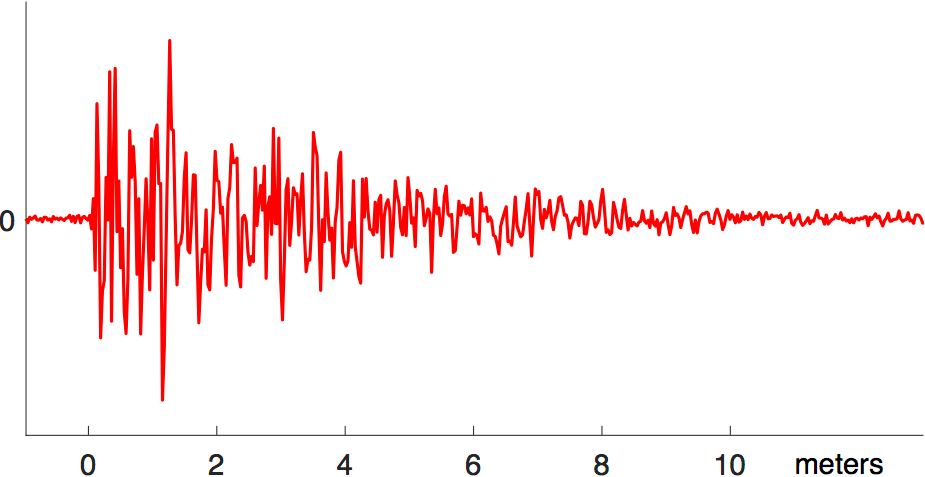
INCREMENTAL EFFECT OF PASSENGER.
The point is: driving with open windows and/or with your fiancé(e) is de-facto compromising the sound equalization settings, hence your in-car music experience. Here is when proactivaudio patented technology comes to rescue, as it is capable of estimating adaptively the interior acoustics under any hostile situation, such as with engine or wind noise, passenger conversation, or even singing while driving 8-) . As final note, in order to adjust automatically the perceptual equalization in the cockpit, the current fingerprint of the interior acoustics is indispensable.